Benchmarking
How to benchmark Bun
Bun is designed for speed. Hot paths are extensively profiled and benchmarked. The source code for all of Bun's public benchmarks is in the /bench directory of the Bun repo.
Measuring time
To measure time precisely, Bun offers two runtime APIs:
- The Web-standard
performance.now()function Bun.nanoseconds(), which is likeperformance.now()except it returns the time since the application started in nanoseconds. Useperformance.timeOriginto convert this to a Unix timestamp.
Benchmarking tools
- For microbenchmarks, we recommend
mitata. - For load testing, you must use an HTTP benchmarking tool that is at least as fast as
Bun.serve(), or your results will be skewed. Some popular Node.js-based benchmarking tools likeautocannonare not fast enough. We recommend one of the following: - For benchmarking scripts or CLI commands, we recommend
hyperfine.
Measuring memory usage
Bun has two heaps: one for the JavaScript runtime, and one for everything else.
JavaScript heap stats
The bun:jsc module exposes a few functions for measuring memory usage:
import { heapStats } from "bun:jsc";
console.log(heapStats());JavaScript is a garbage-collected language, not reference counted. It's normal and correct for objects to not be freed immediately in all cases, though it's not normal for objects to never be freed.
To force garbage collection to run manually:
Bun.gc(true); // synchronous
Bun.gc(false); // asynchronous
Heap snapshots show which objects are not being freed. Use Bun.generateHeapSnapshot() to take a heap snapshot, then view it with Safari or WebKit GTK developer tools. To generate a heap snapshot:
import { generateHeapSnapshot } from "bun";

const snapshot = generateHeapSnapshot();
await Bun.write("heap.json", JSON.stringify(snapshot, null, 2));
To view the snapshot, open the heap.json file in Safari's Developer Tools (or WebKit GTK):
- Open the Developer Tools
- Click "Timeline"
- Click "JavaScript Allocations" in the menu on the left. It might not be visible until you click the pencil icon to show all the timelines
- Click "Import" and select your heap snapshot JSON
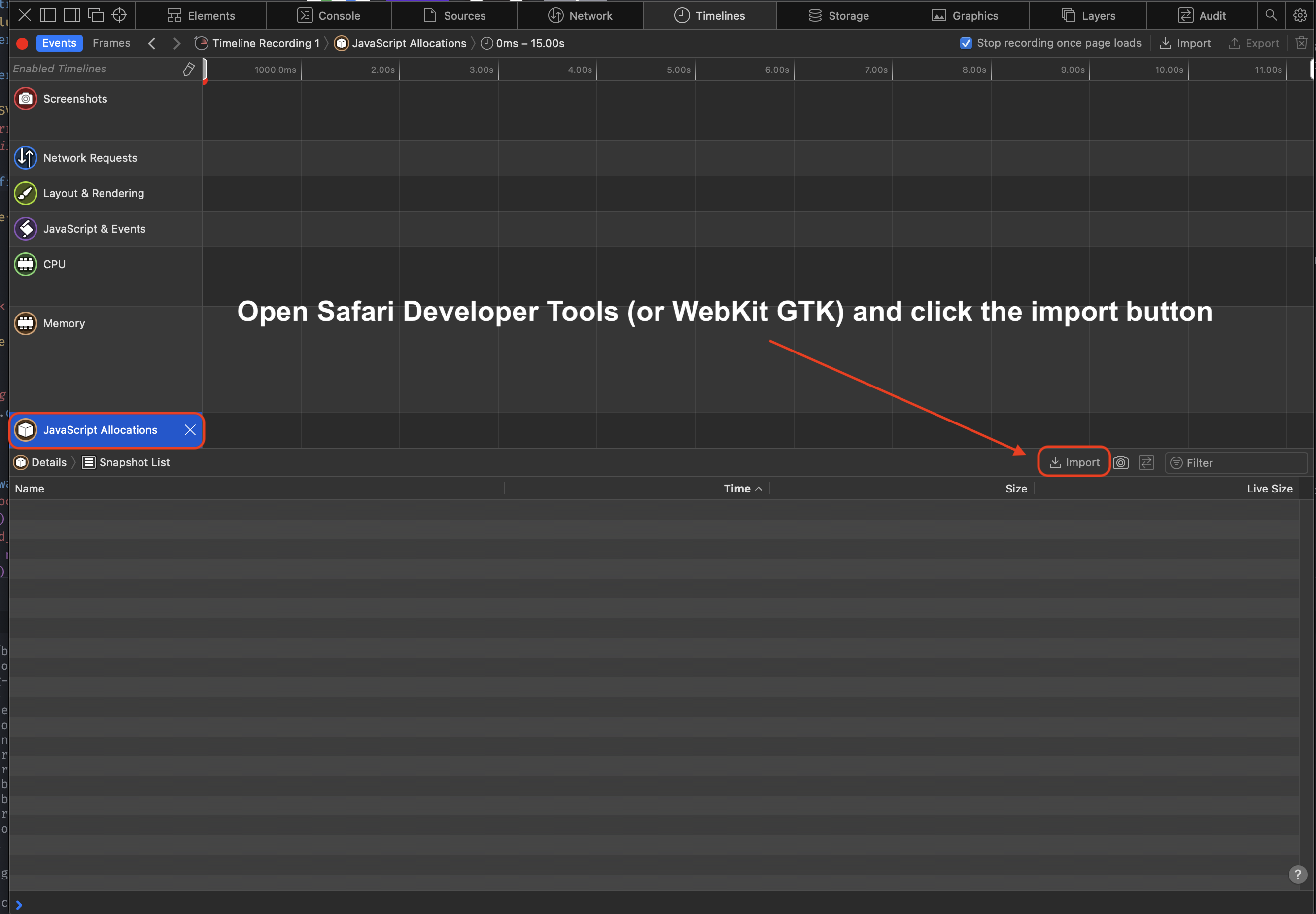
Once imported, you should see something like this:
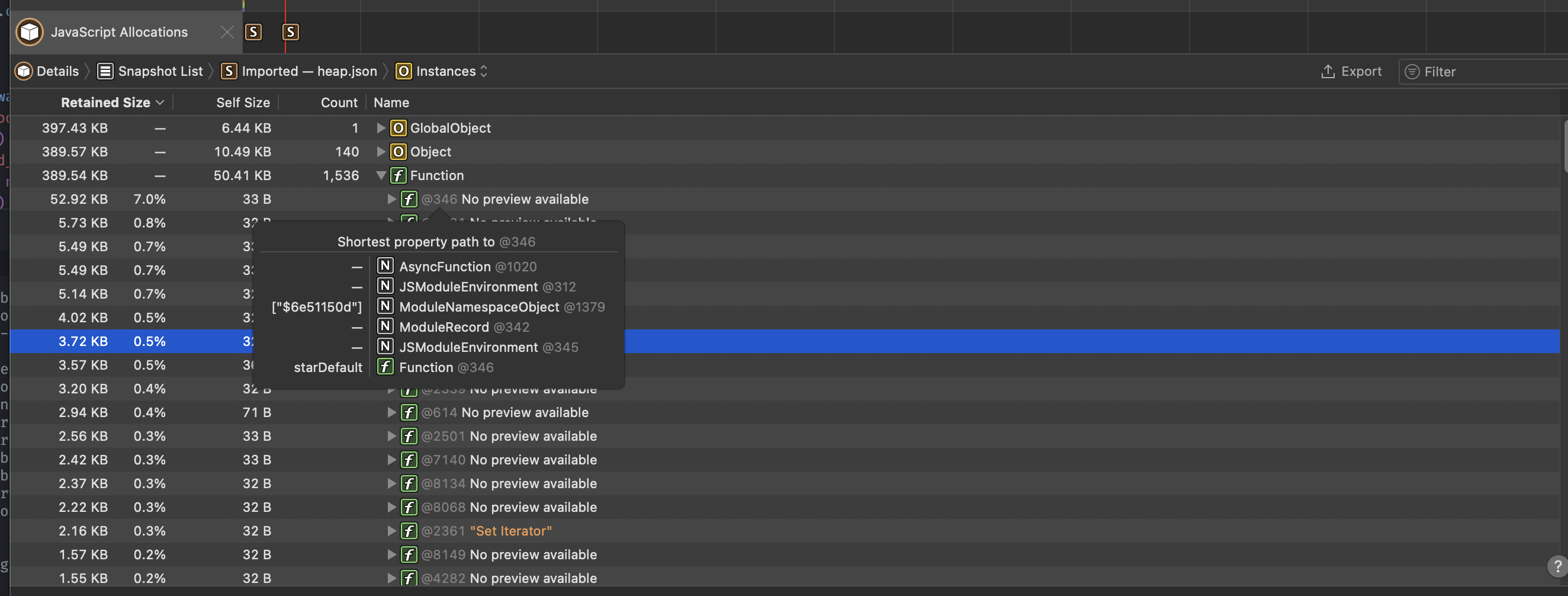
The web debugger timeline also tracks the memory usage of the running debug session.
Native heap stats
Bun uses mimalloc for the other heap. To print a summary of non-JavaScript memory usage, call Bun.unsafe.mimallocDump().
Bun.unsafe.mimallocDump();heap stats: peak total freed current unit count
reserved: 64.0 MiB 64.0 MiB 0 64.0 MiB not all freed!
committed: 64.0 MiB 64.0 MiB 0 64.0 MiB not all freed!
reset: 0 0 0 0 ok
touched: 128.5 KiB 128.5 KiB 5.4 MiB -5.3 MiB ok
segments: 1 1 0 1 not all freed!
-abandoned: 0 0 0 0 ok
-cached: 0 0 0 0 ok
pages: 0 0 53 -53 ok
-abandoned: 0 0 0 0 ok
-extended: 0
-noretire: 0
mmaps: 0
commits: 0
threads: 0 0 0 0 ok
searches: 0.0 avg
numa nodes: 1
elapsed: 0.068 s
process: user: 0.061 s, system: 0.014 s, faults: 0, rss: 57.4 MiB, commit: 64.0 MiBCPU profiling
Profile JavaScript execution to identify performance bottlenecks with the --cpu-prof flag.
$ bun --cpu-prof script.js--cpu-prof writes a .cpuprofile file you can open in Chrome DevTools (Performance tab → Load profile) or VS Code's CPU profiler.
Markdown output
Use --cpu-prof-md to generate a markdown CPU profile, which is grep-friendly and designed for LLM analysis:
$ bun --cpu-prof-md script.jsCombine --cpu-prof and --cpu-prof-md to generate both formats at once:
$ bun --cpu-prof --cpu-prof-md script.jsYou can also pass the flag through the BUN_OPTIONS environment variable:
$ BUN_OPTIONS="--cpu-prof-md" bun script.jsOptions
$ bun --cpu-prof --cpu-prof-name my-profile.cpuprofile script.js
$ bun --cpu-prof --cpu-prof-dir ./profiles script.js| Flag | Description |
|---|---|
--cpu-prof | Generate a .cpuprofile JSON file (Chrome DevTools format) |
--cpu-prof-md | Generate a markdown CPU profile (grep/LLM-friendly) |
--cpu-prof-name <filename> | Set output filename |
--cpu-prof-dir <dir> | Set output directory |
Heap profiling
Write a heap profile on exit to analyze memory usage and find memory leaks.
$ bun --heap-prof script.js--heap-prof writes a full V8-format heap snapshot on exit, using Node.js's
diagnostic filename format
(Heap.<yyyymmdd>.<hhmmss>.<pid>.<tid>.<seq>.heapprofile). The content is the
same as v8.writeHeapSnapshot() / Bun.generateHeapSnapshot("v8"): load it in
Chrome DevTools via Memory tab → Load (pick "All Files" or rename to
.heapsnapshot — the extension follows Node's --heap-prof filename contract,
which the harness and tooling key on).
Markdown output
Use --heap-prof-md to generate a markdown heap profile for CLI analysis:
$ bun --heap-prof-md script.js--heap-prof and --heap-prof-md are specified, the markdown format is used.Options
$ bun --heap-prof --heap-prof-name my-profile.heapprofile script.js
$ bun --heap-prof --heap-prof-dir ./profiles script.js| Flag | Description |
|---|---|
--heap-prof | Write a .heapprofile file on exit |
--heap-prof-md | Generate a markdown heap profile on exit |
--heap-prof-name <filename> | Set output filename |
--heap-prof-dir <dir> | Set output directory |
--heap-prof-interval <bytes> | Accepted for Node.js compatibility (the snapshot is taken once at exit; JavaScriptCore has no allocation sampling to apply an interval to) |